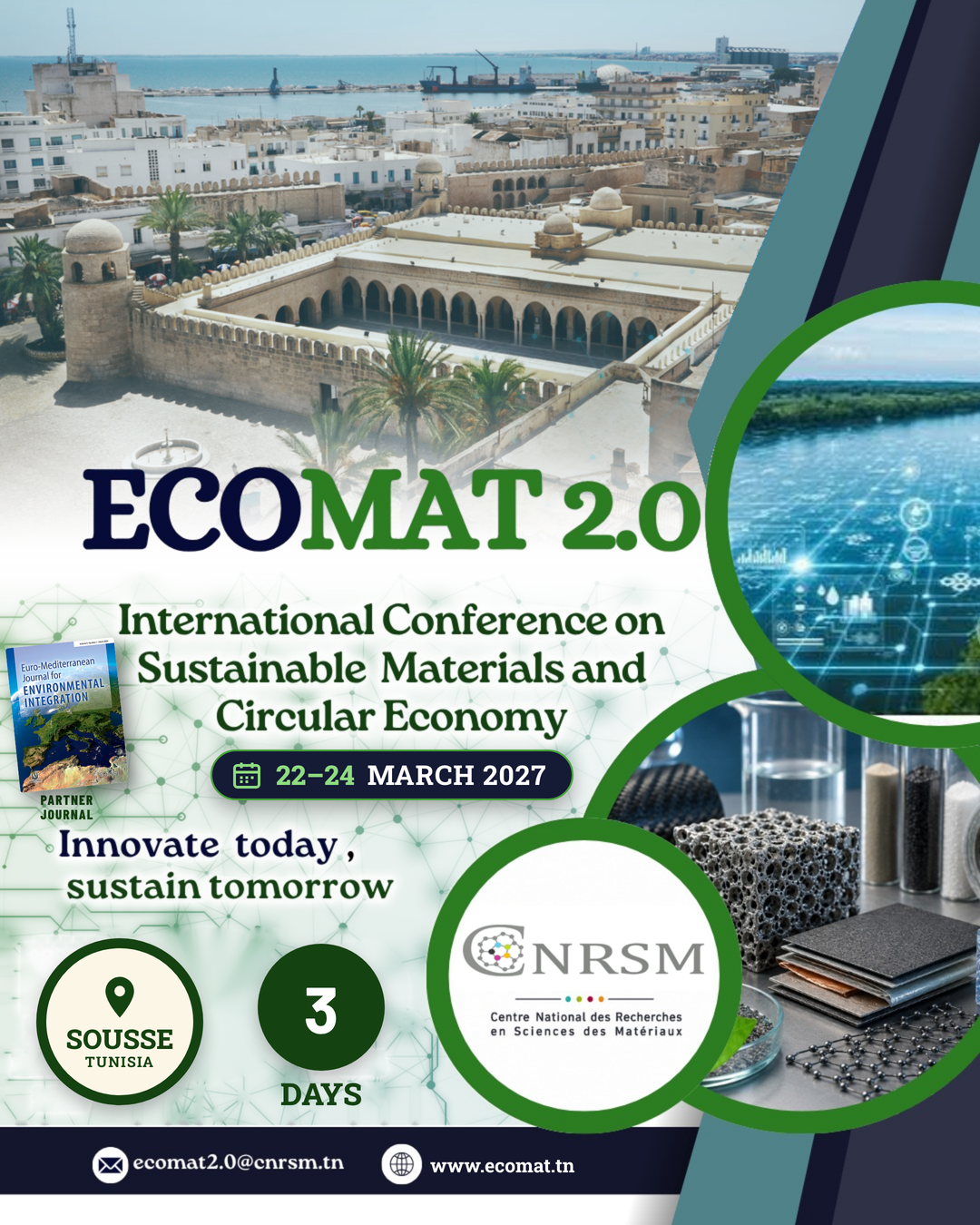
Event onMarch22–242027

2nd International Conference

ECOMAT 2.0

International Conference on Sustainable Materials and Circular Economy

Theme: Innovate today, sustain tomorrow

Sousse, Tunisia

C₆₀ fullerene · graphene · carbon nanotubes

The conference starts in

—Days
—Hours
—Minutes
Welcome

About the conference

We are pleased to invite you to take part in the 2nd International Conference ECOMAT 2.0, to be held from 22 to 24 March 2027 in Sousse, Tunisia.

ECOMAT 2.0 brings together researchers, academics, industry professionals, start-ups and students around one shared goal: designing materials and processes that make better use of natural resources and turn wastes into value.

Over three days, the programme combines plenary lectures by internationally recognised scientists, parallel oral and e-poster sessions, and an Industry & Innovation Day dedicated to technology transfer and academia–industry partnerships. Early-career researchers and students are warmly encouraged to take part.

The main objectives are to support research and innovation, promote the exchange of scientific knowledge, and build new partnerships while strengthening existing collaborations worldwide. Virtual options will be provided for the keynote presentations and the plenary session.

Target audience

  • Industry executives & engineers
  • Junior & senior scientists
  • Stakeholders & policy makers
  • Professionals & academics
  • Start-ups & entrepreneurs
  • PhD & Master's students
Scientific topics

Sessions & tracks

  1. T01

    Sustainable Materials & Circular Economy

    Submit →
  2. T02

    Energy, Environment & Water Technologies

    Submit →
  3. T03

    Advanced Materials & Smart Technologies

    Submit →
  4. T04

    Construction, Metallurgy & Composite Materials

    Submit →
  5. T05

    Biomaterials, Health & Sustainable Agriculture

    Submit →
  6. T06

    Mineral Materials & Applications

    Submit →
  7. T07

    Computational Materials Science

    Submit →
  8. T08

    Innovation, Entrepreneurship & Technology Transfer

    Submit →
500+Participants
20+Countries
50+Industrials
150+Presentations
Programme

Three days of science & industry

01
Day 1 · 22 March

Opening & Plenaries

Opening ceremony, high-level keynote talks and plenary sessions.

02
Day 2 · 23 March

Scientific Programme

Parallel sessions across all themes, oral and e-poster presentations.

03
Day 3 · 24 March

Industry & Innovation Day

Industrial exhibition, B2B matchmaking, start-up showcase, policy and strategy forum.

Invited lectures (35 min) · Oral communications (15 min) · E-poster sessions. The detailed programme will be published on this website.

Invited speakers

Ten speakers from nine countries

Prof. Sébastien Garbarino

Director of Innovation & Infrastructure, PRIMA Québec (Advanced Materials Research and Innovation Hub) · Horizon Europe and International Coordinator for Québec's RSRIs

Canada (Québec)Energy storage & conversion materialsInnovation partnerships
Collaboration and FuturesQuebec and Tunisia: Materials for Moving Forward Together

Sébastien Garbarino has served as Director of Innovation & Infrastructure at PRIMA Québec since 2018. Holding an MSc from France and a PhD from Ireland, and with over a decade of experience as a research scientist in Canada, Dr. Garbarino is an expert in the chemistry and materials used for energy storage and conversion systems. He is the inventor behind three patents and the author of 67 publications. He also serves on the scientific committees of major strategic initiatives, such as the National Asbestos Observatory (ONA), and Canadian training programs. Having received awards in numerous innovation competitions, he has deep insight into Québec's innovation ecosystem and funding landscape. Since 2025, he has acted as the Horizon Europe and International Coordinator for Québec's nine Sectoral Research and Innovation Groups (RSRIs), supporting stakeholders in the province's research and innovation ecosystem (over 1,500 members, 78% of which are businesses) in developing international collaborative research projects, particularly under Horizon Europe.

Talk. Innovation Partnership – Industry-Academia Collaboration – Horizon Europe. This conference will showcase Quebec's advanced materials sector and the cross-cutting role materials play across Quebec's eight other strategic R&D&I sectors. It will also present the unique model of the nine RSRIs, designed to foster industry-academia collaboration, and their mandate regarding international partnerships (bilateral, Horizon Europe, etc.), while highlighting existing initiatives aimed at strengthening collaboration between Quebec and Tunisia.

Prof. Bart Van der Bruggen

University of Leuven (KU Leuven), Department of Chemical Engineering

BelgiumMembrane scienceSustainable separation processes

Bart Van der Bruggen is professor at the University of Leuven (KU Leuven) in Belgium, where he leads a group of 30 PhD students in the research division "Process Engineering for Sustainable Systems" within the department of Chemical Engineering. His expertise is in separation technologies for sustainable processes, with an emphasis on membrane science and technology.

He has authored over 900 publications related to membrane technology in international scientific journals and 30 book chapters (current h-index: 119, Web of Science). He was President of the European Membrane Society (EMS) from 2013 to 2017, and Founding President of the World Association of Membrane Societies (2017–2020). Since 2014 he has also been Extraordinary Professor at Tshwane University of Technology (South Africa), and professor at the Technical University of Ostrava (Czech Republic) and Korea University (Seoul) since 2024. He is editor of several scientific journals, including Separation and Purification Technology (Editor-in-Chief), Journal of Chemical Technology and Biotechnology, Heliyon and Process Safety and Environmental Protection.

Prof. Ali Zazoua

MSBY University – Jijel · Director of the LEAM Laboratory

AlgeriaSensors & biosensorsWater treatment
ThemeEnergy, Environment and Technologies

Ali Zazoua has been a Full Professor since 2015 at MSBY University – Jijel. Former Vice-Rector of External Relations, President of the Scientific Council of the Faculty of Science and Technology of the same university and current director of the LEAM Laboratory, he holds a State Engineer degree in Process Engineering, a Magister and Doctorate in Science and a Habilitation in Chemical Engineering. His research field covers sensors and biosensors in the environmental, medical and agri-food fields; chemistry and water treatment are also among his interests. He has led about fifteen national and international projects (PHC-Maghreb, CMEP, PNR, projects with socio-economic impact, PRFU), with about forty articles in internationally renowned journals and more than a hundred plenary lectures, conferences and communications in Algeria and abroad.

Prof. Luciano Scaltrito

Politecnico di Torino, Department of Applied Science and Technology (DISAT) · Chilab (ITEM)

ItalyCeramic 3D printingNanomaterials & MEMSTechnology transfer
TalkCircularity implementation in Ceramic 3D printing supply chain

Luciano Scaltrito is Full Professor in the Department of Applied Science and Technology (DISAT) at Politecnico di Torino, where he leads a research team at Chilab (ITEM) and serves as Head of Technology Transfer for the department. With over 20 years of experience, his research covers optoelectronic devices in wide band gap materials, nanostructures and nanomaterials for microsensors and polymer composites, 3D additive printing for industrial manufacturing, and MEMS devices. He has authored more than 100 research papers and 3 book chapters, holds two patents transferred to industry (Eni S.p.A. and Martur Italy), and coordinates numerous European, national and industry-funded projects. He founded the spin-off Microla Optoelectronics, which he chaired until 2015, and chaired the Board of Directors of the Italian Association of Science and Technology (AIV) from 2018 to 2020.

Talk. The transition from the traditional linear model "Make – Use – Dispose" to a circular one needs the support of fabrication technologies and innovative material sources to meet the 5R requirements. In this context, Ceramic Additive Manufacturing (CerAM) offers the potential for waste reduction and reintroduction, together with free-form design fabrication. This is the rationale behind exploring the feasibility of a closed-loop approach applied to Digital Light Processing (DLP) technology, by incorporating recycled Al₂O₃ powders collected from different sources into photocurable resins for DLP. The recovered powders were characterized morphologically and compositionally, the related suspensions were rheologically tested and their curing behaviour evaluated. The printed parts were then characterized for density, shrinkage and mechanical properties. The results confirmed the printability and stability of the resins, and the promising mechanical performance of the final parts. This work is a practical proof of concept for reusing ceramic waste in CerAM, opening innovative solutions for waste recovery in line with sustainable manufacturing principles.

Prof. Ayhan Oral

Department of Chemistry, Çanakkale Onsekiz Mart University

TürkiyePolymer chemistryNanofibers & nanocomposites

Ayhan Oral is a full-time professor at the Department of Chemistry at Çanakkale Onsekiz Mart University. He obtained his BSc and MSc in Chemistry at İnönü University and Çanakkale Onsekiz Mart University, and earned his PhD in chemistry at Ege University in 2007, where he worked on the development and preparation of nanocomposites. He served as chairman of the audit committee of the Chemists Society of Türkiye and is currently its deputy president. He is founder and chairman of the International Joint Congress of Materials and Polymers. His main research fields are polymer chemistry and nanochemistry, with expertise in nanofibers, nanocomposites and biopolymer materials for applications such as drug release, wound healing and bio-scaffolds. h-index 13, 38 published articles, 585 citations.

Prof. Paulo Mourão

University of Évora

PortugalPorous materials & adsorbentsWaste valorization

P.A.M. Mourão is a permanent researcher at the University of Évora, Portugal. He holds a degree in Physics and Chemistry, a master's in Physics and a PhD in Chemistry in the area of Materials and Surfaces. In recent years he has consolidated his research on the preparation, characterization, development and application of porous materials, focusing on the recovery and valorization of raw materials and wastes from natural and synthetic sources by transforming them into adsorbents for the liquid phase (dyes, pesticides, pharmaceuticals, metals) and the gas phase (CO₂), guided by a circular economy perspective.

Prof. Mohamed M. Elgohary

President of Borg Alarab Technological University · Faculty of Engineering, Alexandria University

EgyptNaval architecture & marine engineeringGreen energy & alternative fuelsEnergy storage & fuel cells

Prof. Dr. Mohamed Morsy Elgohary is an Egyptian academic and leader in Naval Architecture and Marine Engineering. He has been President of Borg Alarab Technological University since 2022. He previously headed the Naval Architecture and Marine Engineering Department at the Faculty of Engineering, Alexandria University (2017–2022), and the Marine Engineering Department at King Abdul-Aziz University in Jeddah, Saudi Arabia (2011–2017). He holds a BSc (1992) and MSc (1996) in Naval Architecture and Marine Engineering from Alexandria University and a PhD in Mechanical Engineering from Hannover University, Germany (2004).

His research focuses on green energy, marine power plants, alternative fuels, energy storage, fuel cells, diesel engines and computational fluid dynamics (CFD). He has authored and co-authored numerous papers in journals such as Ocean Engineering, Environmental Science and Pollution Research and Alexandria Engineering Journal, received several Alexandria University awards for publications in ISI-indexed journals, and reviews for leading journals in marine engineering and ocean technology. He is a member of the Society of Naval Architects and Marine Engineers (SNAME), the Egyptian Engineers Syndicate and transport-related advisory committees.

Prof. Olfa Kanoun

Chair of Measurement and Sensor Technology, Chemnitz University of Technology

GermanySensor technologyImpedance spectroscopyNanomaterials

Prof. Dr. Olfa Kanoun holds the Chair of Measurement and Sensor Technology at Chemnitz University of Technology. Born and raised in Sfax, she studied in Germany and established herself internationally as a leading expert in sensor technology, impedance spectroscopy and nanomaterials. On 28 August 2025 she received the President of the Republic of Tunisia’s prize for the best Tunisian researcher living abroad.

She received her doctorate from the University of the Federal Armed Forces in Munich in 2001 (dissertation prize of AHMT e.V.) and founded the Impedance Spectroscopy working group there. In 2006 she became adjunct professor and head of the Department of Measurement Technology at the University of Kassel, and since 2007 she has been full professor at Chemnitz University of Technology. She founded the International Workshop on Impedance Spectroscopy (IWIS, 2008), the Advanced School on Impedance Spectroscopy (2017) and the Technical Committee Impedance Spectroscopy (TC2, 2018).

She has published over 700 peer-reviewed papers, cited more than 8,000 times, with advances in intelligent sensors, energy-autonomous systems and new diagnostic methods for batteries, health, the environment and industry. In 2022 she received the Technical Award of the IEEE Instrumentation and Measurement Society.

Prof. Hüsnü Gerengi

Department of Mechanical Engineering, Düzce University

TürkiyeCorrosion & corrosion controlCorrosion inhibitorsImpedance spectroscopy (DEIS)

Dr. Hüsnü Gerengi is a professor in the Department of Mechanical Engineering at Düzce University, Türkiye, and has represented his country in the International Corrosion Council (ICC) since 2015. His expertise covers corrosion and corrosion control, corrosion-resistant materials, and the principles and mechanisms of corrosion inhibitors. He was the first researcher to apply Dynamic Electrochemical Impedance Spectroscopy (DEIS) to corrosion-inhibitor studies, quantifying the effectiveness of inhibitors and coatings over time.

He also works on plastic and rubber material technology and additives. Ongoing topics in his laboratory include corrosion-resistant steel, Al, Cu and brass alloys, Mg-based bioresorbable medical implants and corrosion-resistant construction materials. He has given numerous invited lectures, authored more than 60 SCI papers in high-impact journals, and holds seven ongoing patents on boron-doped corrosion inhibitors.

Prof. Georgios E. Christidis

Professor of Economic Geology – Industrial Mineralogy, Technical University of Crete

GreeceClays & zeolitesIndustrial mineralsCritical metals

Georgios E. Christidis is Professor of Economic Geology – Industrial Mineralogy at the Technical University of Crete, Greece. His research covers the characterization, properties and industrial and environmental applications of clays, zeolites, perlites and industrial fillers; critical-metal deposits (Ni, Co, Li) associated with clay horizons; clays in paleoclimatic reconstructions, soils and geoarchaeology; clay–microorganism interactions; and zeolite synthesis.

He has been Principal Editor of Clay Minerals since 2013, and Associate Editor of Applied Clay Science and Clays and Clay Minerals. His awards include the Marion and Chrystie Jackson Mid-Career Clay Scientist Award (CMS, 2013), the George Brown Lecture Award (Mineralogical Society, 2012), the Giovanni Novelli Award (2001) and the Ktenas Award (Academy of Athens, 2006). He has delivered 26 invited keynote or plenary lectures and published more than 140 papers.

Submission guidelines

Abstracts & e-posters

Abstracts

Abstracts in English, on a single A4 page in MS-Word format, following the template available on the website ([font], [size], [margins]). TBC

E-posters

Posters are presented as e-posters (electronic posters displayed on screens). Authors are requested to be present during the official e-poster sessions to discuss their work.

Registration

Registration fees

Maghreb

Participants from the Maghreb

  • Participant750 TND
  • Accompanying person500 TND
  • One-day registration250 TND
  • Industrials900 TND
International

International participants

  • Participant350 €
  • Accompanying person250 €

Registration includes

  • Two-night accommodation (three days) on a Soft All-Inclusive basis at the conference hotel
  • Access to all sessions and digital conference proceedings
  • Printed conference programme
  • Conference gift bag and certificate of presentation
Brochure

Poster & flyer

Conference poster

PNG · 1080 × 1350 px

Download the poster

Tri-fold flyer

PDF · 2 pages A4 landscape (outside + inside)

Download the flyer
CNRSM — Centre National de Recherches en Sciences des Matériaux
About us

Organizer

ECOMAT 2.0 is organized by the Centre National de Recherches en Sciences des Matériaux (CNRSM), Technopole of Borj Cédria, Tunisia.

CNRSM conducts research on the characterization, processing and valorization of natural and secondary resources for materials applications. Through ECOMAT, it aims to create a platform where researchers, engineers and industry partners exchange ideas and build collaborative projects, and to strengthen Tunisia's place in the international eco-materials research network.

Conference Chair: Yasser Ben Amor · Executive Chair: Halim Hammi. See all committees →

Committees

Conference committees

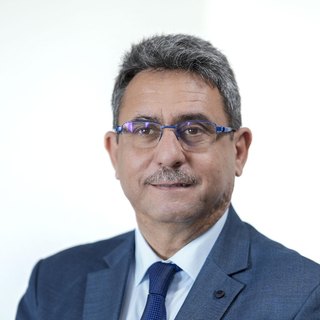
Portrait of Yasser Ben AmorConference ChairYasser BEN AMORCNRSM · Tunisia
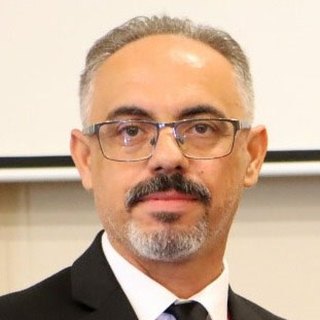
Portrait of Halim HammiExecutive ChairHalim HAMMICNRSM · Tunisia

Scientific Committee

53 members · alphabetical order
  • Nor-Eddine ABRIAKIMT Nord Europe, Douai · France
  • Feten AMMARINNORPI · Tunisia
  • Imen BEKRI ABBESCNRSM · Tunisia
  • Nizar BELLAKHALLINSAT · Tunisia
  • Rim BEN ARFIENIG · Tunisia
  • Hichem BEN JANNETFSM · Tunisia
  • Latifa BERGAOUIINSAT · Tunisia
  • Néji BESBESCNRSM · Tunisia
  • Mongi BOUAICHACRTEn · Tunisia
  • Jamel BOUAZIZENIS · Tunisia
  • Djalila BOUDEMAGHFerhat Abbas University, Sétif 1 · Algeria
  • Mohamed BOUFARESTunisie Ouate · Tunisia
  • Chaker BOUZIDICNRSM · Tunisia
  • Georgios E. CHRISTIDIS SpeakerTechnical University of Crete · Greece
  • Elimame ELALOUIFSG · Tunisia
  • Mohamed M. ELGOHARY SpeakerBorg Alarab Technological University · Egypt
  • Mounir FERHICNRSM · Tunisia
  • Hakim GABTNICERTE · Tunisia
  • Sébastien GARBARINO SpeakerPRIMA Québec · Canada
  • Ahlem GARBOUTCNRSM · Tunisia
  • Hüsnü GERENGI SpeakerDüzce University · Türkiye
  • Abdelmalek GHANNEMCEO, SOIB · Tunisia
  • Amina GHARBIMichigan State University · USA
  • Achraf GHORBALISSATG · Tunisia
  • Ayoub HAJ SAIDCRMN · Tunisia
  • Anouar HAJJAJICRTEn · Tunisia
  • Ahmed Hichem HAMZAOUICNRSM · Tunisia
  • Salah HANNACHIAtlas Consult · Tunisia
  • Karima HORCHANI-NAIFERCNRSM · Tunisia
  • Sana HRAIECHCNRSM · Tunisia
  • Mohamed JAZIRIFST · Tunisia
  • Dorra JELLOULICNRSM · Tunisia
  • Olfa KANOUN SpeakerChemnitz University of Technology · Germany
  • Karim KHILACPG · Tunisia
  • Hatem MAJDOUBFSM · Tunisia
  • Oumaya MARZOUKCEREMA · France
  • Ousseynou M'BODJNouakchott University · Mauritania
  • Adel MEGRICHEFST · Tunisia
  • Besma MELLAHCNRSM · Tunisia
  • Chokri MESSAOUDCBBC · Tunisia
  • Adel MNIFCNRSM · Tunisia
  • Ferid MOKHTARCNRSM · Tunisia
  • Paulo MOURÃO SpeakerUniversity of Évora · Portugal
  • Ayhan ORAL SpeakerÇanakkale Onsekiz Mart University · Türkiye
  • Khaled OTHMANONM · Tunisia
  • Basma SAMETENIS · Tunisia
  • Luciano SCALTRITO SpeakerPolitecnico di Torino · Italy
  • Ezzeddine SRASRACNRSM · Tunisia
  • Najoua SRASRA FRINICNRSM · Tunisia
  • Ezzeddine TRIKICNRSM · Tunisia
  • Mohamed TRIKICNRSM · Tunisia
  • Bart VAN DER BRUGGEN SpeakerKU Leuven · Belgium
  • Ali ZAZOUA SpeakerMSBY University – Jijel · Algeria

Organizing Committee

15 members
  • Ghada RHIMICNRSM · Tunisia
  • Refka OUESLATICNRSM · Tunisia
  • Khaoula MKADMINICNRSM · Tunisia
  • Mohamed MEZNICNRSM · Tunisia
  • Faïcel KHLISSACNRSM · Tunisia
  • Dorra JELLOULICNRSM · Tunisia
  • Anouar HAJJAJICRTEn · Tunisia
  • Fatma HABBACHICNRSM · Tunisia
  • Sana FRIDJINECNRSM · Tunisia
  • Kais DJEBALICNRSM · Tunisia
  • Moufida BORNICNRSM · Tunisia
  • Youssef BEN SMIDACNRSM · Tunisia
  • Rafika BEN SGHAIERCNRSM · Tunisia
  • Nour El Houda BEN AMMARCNRSM · Tunisia
  • Sameh ATTIACNRSM · Tunisia

Executive Committee

6 members
  • Yasser BEN AMORCNRSM · Tunisia
  • Halim HAMMICNRSM · Tunisia
  • Dorra JELLOULICNRSM · Tunisia
  • Rafika BEN SGHAIERCNRSM · Tunisia
  • Ghada RHIMICNRSM · Tunisia
  • Sinda SASSICNRSM · Tunisia